What is Heat Check

A live debate experience where pressure becomes practice.

We are not short on opinions. We are short on practice staying present when conversations get intense.

Heat Check is a facilitated live experience led by Cirak that combines fast-paced debate, nervous-system awareness, and guided self-regulation.

Participants take opposing positions on a topic selected with the host and begin debating face-to-face. Participants tag in and out as the debate unfolds, creating a fast-moving conversation where everyone has the opportunity to step into the heat.

As different voices enter the conversation, positions are challenged, the energy builds, and the whole room becomes part of what is happening.

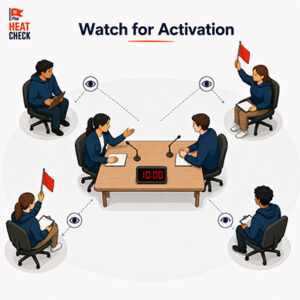
Trained facilitators watch for rising activation and raise red Heat Check flags when the pressure reaches a threshold.

When the flags go up, everything stops. No one is judged. No one is shamed. No one is voted out.

Instead, the entire room pauses together while Cirak guides participants through a few minutes of simple sensation awareness—observing what is happening in the body without reacting to it.

Then the debate comes alive again.

Heat Check turns disagreement into a live practice: get activated, notice it, regulate, and return.

The goal isn’t to eliminate intensity. It’s to discover what happens when you can stay present inside it

Why This Matters

Universities, workplaces, organizations, and communities all ask people to navigate disagreement. But few of us ever practice what to do when disagreement becomes personal, physical, and emotionally activating.

Heat Check gives people that practice—in real time.

Participants experience activation, rather than merely talking about it

Heat Check deliberately creates enough pressure for students to notice defensiveness, urgency, frustration, excitement, and the impulse to react as they are happening.

The whole room practices regulation together

Because participants rotate through the debate and stay actively engaged with it, the pause is not simply for one person who became “too emotional.” Everyone stops. Everyone checks in. Everyone practices.

Dialogue becomes more flexible and less reactive

Students discover that disagreement can continue after activation. They can pause, regulate, and return without needing to withdraw, attack, or force agreement.
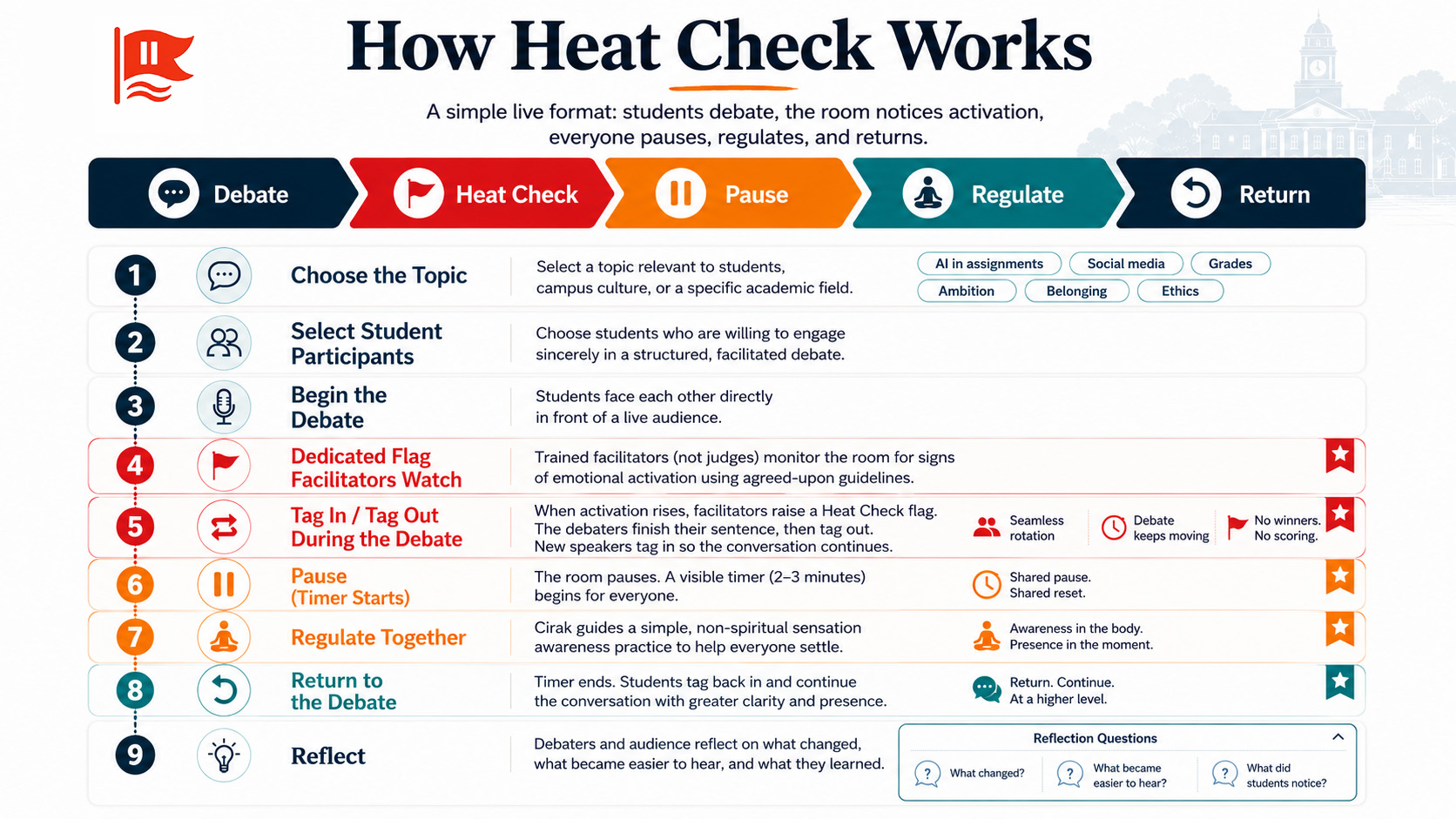
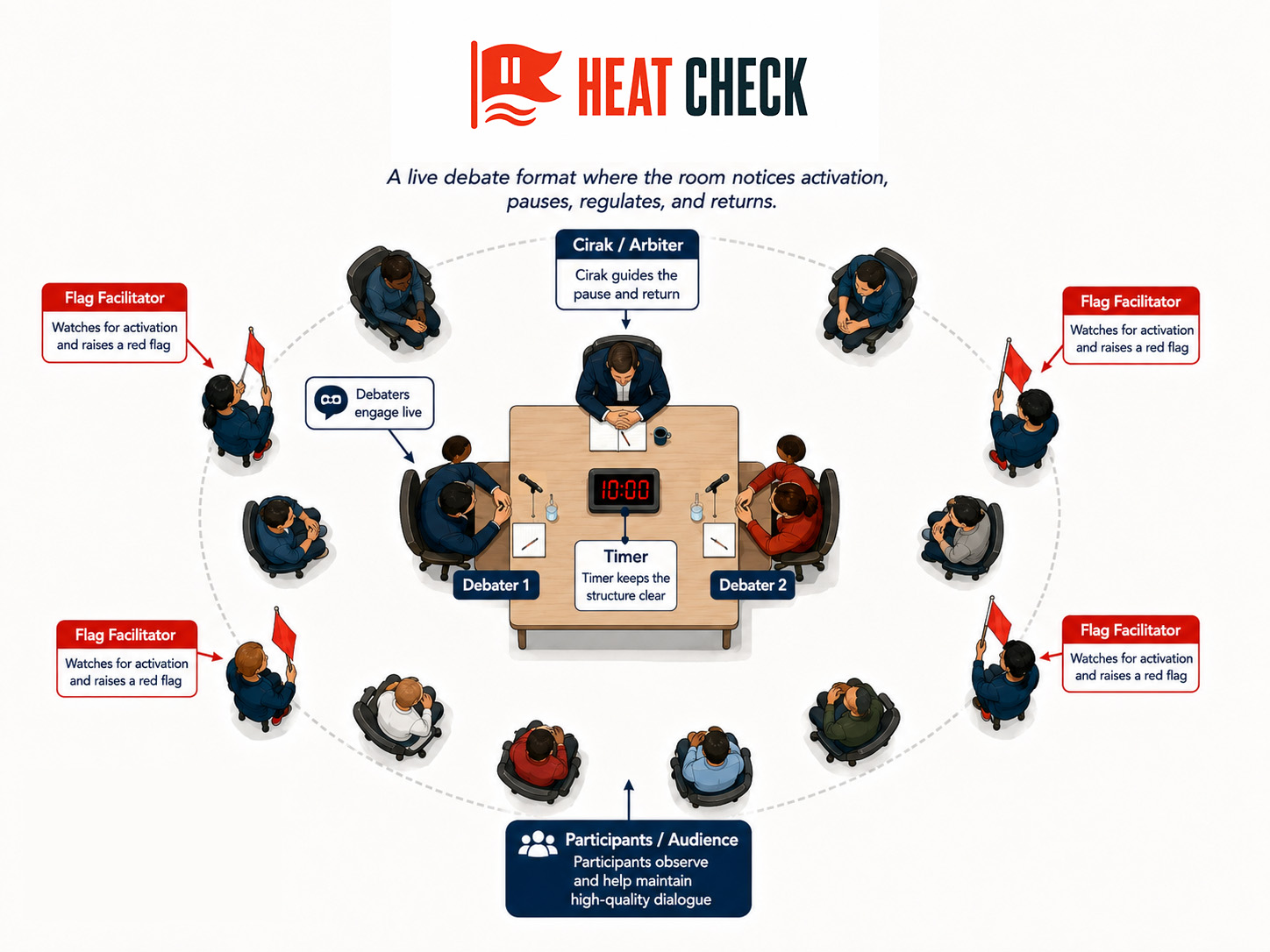
How Heat Check Works

CLICK TO ZOOM 🔍

Why This is Different

Most debates ask: Who made the better argument?

Heat Check asks: What happens to you while you’re arguing?

Participants tag in. Participants tag out. Voices change. Pressure builds. The room gets invested. And then, right when the instinct is to push harder, defend, attack, withdraw, or prove your point—we pause.

That interruption is the practice.

  • Participants tag in and out of the debate
  • Participation is dynamic rather than fixed
  • No one is eliminated or voted out
  • The Heat Check flag is never punitive
  • Activation becomes something to observe, not suppress
  • The entire room pauses together
  • Regulation happens inside the difficult conversation
  • The debate resumes after every pause
  • Agreement is never required

Heat Check does not avoid tension. It teaches people how to meet it.

What Participants Say

Who This is For

Student affairs · leadership programs · residence life · honors colleges · debate teams · professional schools · civil discourse initiatives

Leadership teams · professional associations · workplace learning · culture and dialogue programs

Conferences · festivals · summits · public conversations · community events

Civic groups · dialogue initiatives · retreat centers · intentional communities

Heat Check can be presented as a public event, leadership experience, facilitated dialogue, professional-development program, or part of a broader initiative around communication, resilience, or civil discourse.

Program Format

Length: 90 minutes
Best for: Public events, campuses, conferences, leadership programs, and first-time Heat Check experiences

Includes:

  • Opening framework by Cirak
  • Debate topic introduced
  • Live rotating debate with student tag-ins
  • Heat Check flag moments
  • Whole-room guided regulation
  • Debate restart and continued rotation
  • Closing participant reflection
  • Audience Q&A

Length: 2 hours
Best for: Groups that want more participant rotation, multiple debate rounds, and deeper audience reflection

Includes everything in the Signature Event, plus:

  • More debate rounds and participant rotation
  • More opportunities to tag into the conversation
  • Multiple Heat Check / regulation cycles
  • Longer participant and audience reflection
  • Closing discussion on applying the practice to classrooms, relationships, leadership, and campus dialogue

Length: 3–4 hours
Best for: Leadership cohorts, student leaders, professional teams, facilitators, and groups wanting training alongside the live experience

Includes:

  • Heat Check live debate
  • Guided self-regulation training
  • Small-group practice
  • Facilitator briefing
  • Discussion on applying the practice to relationships, leadership, teams, classrooms, and difficult conversations beyond the event

FAQ

To host Heat Check, the organization typically provides:

  • A venue suitable for a live audience
  • Basic A/V support
  • Two microphones for debaters
  • One wireless microphone for Cirak
  • Seating arranged so debaters can face each other
  • Seating for participants
  • 2–4 flag facilitators
  • One planning liaison
  • Promotion / participant recruitment
  • A short pre-event planning call
  • Optional permission to film selected portions for documentation or future promotion


Heat Check can be staged in an auditorium, lecture hall,  conference room, theater, studio, event space, student center, or flexible gathering space.

Cirak provides:

  • Event concept and facilitation
  • Opening framework
  • Guided regulation practice
  • Live moderation
  • Heat Check format
  • Pre-event planning call
  • Facilitator briefing
  • Topic guidance
  • Closing reflection
  • Optional student leader workshop
  • Optional post-event survey questions


The format can be adapted to the needs of the host, audience, and setting.

Heat Check is designed to be challenging but respectful.

The event is not therapy, political advocacy, or religious teaching.

It is a live educational experience in self-regulation, dialogue, and presence under pressure.

Core principles:

  • Participation is voluntary
  • Topics are selected with the host
  • No participant is publicly diagnosed or labeled
  • The Heat Check flag is not punitive
  • Participants choose when to tag in and when to tag out
  • Pauses apply to the whole room, not just one person
  • The goal is not agreement
  • The goal is awareness, regulation, and return


Participants are invited to disagree honestly while learning how to stay connected to themselves and the room.

About Cirak

Cirak is an author, speaker, and facilitator known for making inner awareness practical, direct, and accessible.

His work focuses on presence, emotional clarity, self-regulation, and living from a deeper intelligence than reactivity. Through books, retreats, live programs, and public talks, he helps people recognize the patterns that drive their lives and return to a more grounded, conscious way of being.

With Heat Check, Cirak brings this work into live public settings—not as meditation, ideology, or belief, but as a practical way to explore what happens when pressure, disagreement, and emotional intensity enter the room.

Learn more: https://cirak.com/

STAY CLOSE TO HEAT CHECK

Follow new debates, participant reactions, upcoming events, and where Heat Check goes next.

Bring Heat Check

Interested in bringing Heat Check to your campus, organization, conference, event, or community? Tell us what you have in mind.

Heat Check | Live Debate
Privacy Overview

This website uses cookies so that we can provide you with the best user experience possible. Cookie information is stored in your browser and performs functions such as recognising you when you return to our website and helping our team to understand which sections of the website you find most interesting and useful.